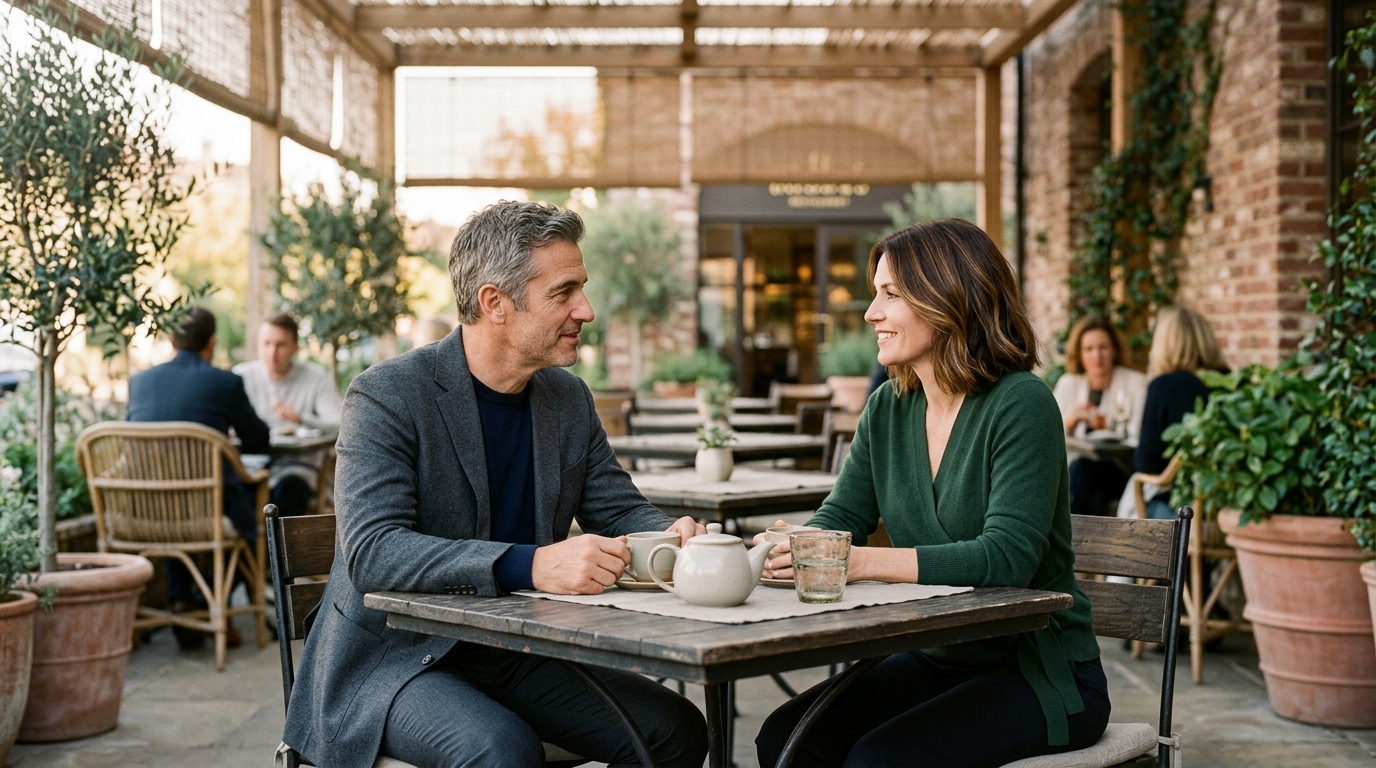
Stepping back into the dating scene in your 40s can feel like navigating a familiar landscape that has somehow shifted its topography. If you are dating again after a long break, or perhaps finding yourself single for the first time in decades, you have likely noticed that the internal compass you used in your 20s or 30s doesn't quite point the same way anymore. This isn’t because the "spark" has disappeared, but rather because your perspective has expanded. In your 40s, dating is less about an urgent quest for identity or meeting societal milestones and more about finding a genuine alignment with the life you have already built.
One of the most significant shifts is the transition from seeking a partner who "looks good on paper" to seeking one who "feels good in practice." In younger years, many of us were influenced by external markers of success—career prestige, social standing, or an idealised version of romance fueled by grand, cinematic gestures. By the time you reach your 40s, life has usually provided a few reality checks. You have likely navigated career highs and lows, health scares, or the complexities of family life. These experiences act as a filter, refining your priorities. You start to realise that while a partner's status might be impressive at a dinner party in Subiaco or a gallery opening in Southbank, it does very little for you when you need someone to share a quiet Tuesday evening with or a person who remains calm when life gets messy.
"The goal often shifts from finding someone to 'build a life with' from scratch, to finding someone whose existing life complements yours without requiring either of you to dismantle who you've become."
This decade often brings a profound sense of "time value." You are likely more protective of your peace and your schedule. Whether you are balancing a demanding role in the CBD, managing the chaotic schedules of school-aged children, or caring for ageing parents, your "free time" is no longer a limitless resource. Consequently, the tolerance for "games," mixed signals, or "breadcrumbing" drops significantly. You aren't necessarily being "picky"; you are being respectful of your own energy. If a connection doesn't show promise of consistency and mutual respect early on, you are far more likely to wish them well and move on, rather than attempting to "fix" or wait out a lukewarm situation.
Refining the Essentials: Values, Consistency, and Emotional Maturity
In your 40s, the concept of "compatibility" takes on a much deeper meaning. It moves beyond sharing a love for the same indie bands or weekend trips to the coast. Instead, it centres on lifestyle fit and shared values. You might find yourself asking: Do our communication styles mesh? Are we on the same page regarding financial stability? How do they treat people in the service industry? These observations provide more insight into a person’s character than any grand romantic speech ever could.
- Consistency over Intensity: You likely now value the person who texts when they say they will, over the person who sends a hundred roses but disappears for a week.
- Emotional Regulation: The "dramatic" highs and lows that felt like "passion" in your 20s often look like a red flag for a lack of emotional maturity now.
- Respectful Autonomy: Recognising that both partners have established lives, hobbies, and friendships, and seeing that independence as a strength rather than a threat.
- Shared Reliability: Trust is built in the small moments—showing up on time, following through on plans, and being an emotional "safe harbour."
Consider the example of someone like Sarah. In her 20s, she was always drawn to the "charismatic enigma"—the person who was exciting but unpredictable. Now, in her 40s, she finds herself prioritising "boring" traits like reliability and clear communication. She realised that the anxiety caused by unpredictability wasn't actually "chemistry"; it was just stress. She now looks for a partner who offers a sense of calm, someone whose presence feels like a deep breath rather than a bated one.
For those with children, expectations undergo an even more practical transformation. You aren't just looking for a romantic partner; you are looking for someone who respects your role as a parent and understands that your children are a non-negotiable priority. You are less interested in an "idealised fantasy" of a partner and more interested in someone who fits into the beautiful, sometimes chaotic reality of your daily life. This might mean dates are scheduled two weeks in advance, or that a "perfect" evening involves a takeaway pizza and a movie once the kids are asleep, rather than a late-night bar crawl through the city.
A Note on Safety: As priorities shift toward intentional dating, it is also important to stay informed about digital safety. If you are using online platforms to meet new people, always prioritise your security. Official resources like the eSafety Commissioner provide excellent guidelines on how to protect your personal information and navigate the digital dating world safely.

The Balance: Clear Standards Without Becoming Rigid
There is a fine line between having healthy non-negotiables and becoming so set in your ways that you close yourself off to wonderful, albeit unexpected, connections. With age comes a clearer understanding of what didn't work in the past. You might have a list of "dealbreakers" informed by previous relationships—perhaps a lack of transparency, an inability to resolve conflict, or mismatched ambitions. While these lessons are invaluable, they can sometimes lead to a "defensive" style of dating where you are constantly looking for reasons to say "no" rather than reasons to say "yes."
Take the example of Alex. After a relationship that felt like a constant emotional rollercoaster, Alex became very clear about wanting a "drama-free" life. Initially, this led to a very rigid checklist. However, Alex had to learn to distinguish between "healthy conflict"—which is necessary for growth—and "unhealthy drama." By staying open-minded, Alex found that a partner doesn't have to be perfect or agree on everything to provide a stable, respectful environment. The key was learning to balance high standards for character with a realistic expectation for human imperfection.
Another common hurdle is the "comparison trap." When you have a history of significant relationships, it’s easy to measure every new person against an ex-partner—either as a reaction against their flaws or a longing for their specific strengths. This can prevent you from seeing the person sitting across from you for who they actually are. Dating in your 40s is most successful when you can acknowledge your past without letting it dictate your future. Your experiences should be a lantern, not a cage.
Warning: Be cautious of the "Instant Soulmate" myth. Even in your 40s, healthy relationships take time to build. Don't mistake a lack of immediate, overwhelming "fireworks" for a lack of potential. Often, the most enduring connections are the ones that "slow-burn," growing stronger as trust and understanding develop over time.
Ultimately, dating in your 40s is an exercise in self-knowledge. You are likely more comfortable in your own skin than you were twenty years ago. You know your worth, you know your limits, and you know that your happiness isn't solely dependent on your relationship status. This shift in perspective is your greatest strength. It allows you to date with intentionality and grace. Whether you are looking for a lifelong partner, a companion for travel and adventure, or simply someone to share meaningful conversations with, having clearer expectations doesn't limit your options—it simply ensures that the options you choose are the ones truly worth your time.
As you move forward, remember that your priorities can continue to evolve. What you need at 42 might be different from what you need at 48. Stay curious, stay authentic, and trust that your life experience has equipped you with exactly the tools you need to find a connection that is grounded, respectful, and perfectly aligned with the person you are today.